

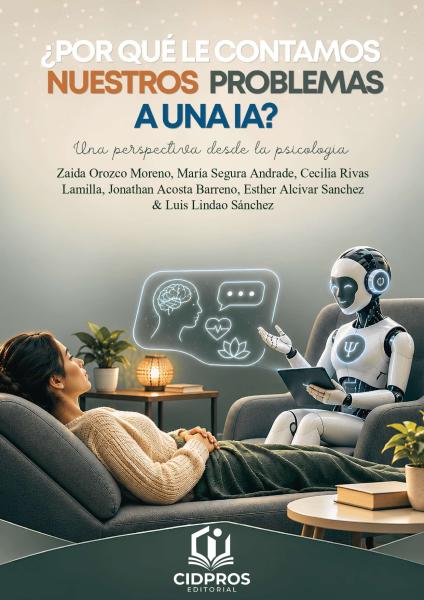
La inteligencia artificial ha transformado las formas de comunicación humana, introduciendo nuevas posibilidades para expresar emociones, compartir preocupaciones y buscar acompañamiento psicológico. La obra ¿Por qué le contamos nuestros problemas a una IA? Una perspectiva desde la psicología analiza las motivaciones que llevan a las personas a confiar sus experiencias personales a sistemas conversacionales, considerando sus necesidades afectivas, sociales y emocionales. El contenido se organiza en cinco capítulos que abordan los fundamentos psicológicos de la escucha, la comunicación emocional, la empatía y la búsqueda de validación. Asimismo, examina la inteligencia artificial como espacio de desahogo, estableciendo diferencias entre las respuestas automatizadas y el acompañamiento psicológico profesional. Se profundiza en la dependencia emocional, la antropomorfización, la búsqueda compulsiva de respuestas, el aislamiento social, la sobrevalidación y los riesgos de la desinformación psicológica. Desde una perspectiva ética y científica, se reflexiona sobre la autonomía personal, la privacidad, la confidencialidad y el consentimiento informado. La obra incorpora fundamentos teóricos, evidencia científica y casos ilustrativos que facilitan la comprensión de estos fenómenos. Su propósito es promover una utilización consciente y responsable de la inteligencia artificial como recurso complementario para el bienestar emocional, preservando la importancia de los vínculos humanos y la atención psicológica profesional especializada.
American Psychiatric Association. (2022). Diagnostic and statistical manual of mental disorders - DSM-5-TR (Quinta edición, revisión del texto (DSM-5-TR) ed.). American Psychiatric Association Publishing. https://www.federaciocatalanatdah.org/wp-content/uploads/2018/12/dsm5-manualdiagnsticoyestadisticodelostrastornosmentales-161006005112.pdf
American Psychological Association. (2017). Ethical principles of psychologists and code of conduct. American Psychological Association. https://www.apa.org/ethics/code?utm_source
American Psychological Association. (2025). Ethical guidance for AI in the professional practice of health service psychology. American Psychological Association. https://www.apa.org/topics/artificial-intelligence-machine-learning/ethical-guidance-ai-professional-practice.html?utm_source
American Psychological Association. (2025a). Artificial intelligence and adolescent well-being: An APA health advisory. American Psychological Association. https://www.apa.org/topics/artificial-intelligence-machine-learning/health-advisory-ai-adolescent-well-being.pdf?utm_source
Arnaiz-Rodriguez, A., Baidal, M., Derner, E., Annable, J., Ball, M., Ince, M., . . . Oliver, N. (2026). Between help and harm: An evaluation study of mental health crisis handling by large language models. JMIR Mental Health, 13, e88435. https://doi.org/10.2196/88435
Baek, C., Tate, T., & Warschauer, M. (2024). “ChatGPT seems too good to be true”: College students’ use and perceptions of generative AI. Computers and Education: Artificial Intelligence, 7, 100294. https://doi.org/10.1016/j.caeai.2024.100294
Beg, M., Verma, M., Chanthar, V., & Verma, M. (2025). Artificial intelligence for psychotherapy: A review of the current state and future directions. Indian Journal of Psychological Medicine, 47(4), 314–325. https://doi.org/10.1177/02537176241260819
Benoit, C. (2023). La escucha empática, una habilidad fundamental para el trabajo colaborativo docente. Revista San Gregorio, 1(54), 165–182. https://doi.org/10.36097/rsan.v1i54.2456
Biscaia, J., Mohedano, R., & Biscaia, C. (2023). La inteligencia artificial en la prevención de conductas suicidas: aspectos técnicos y consideraciones ético-legales. Revista de Bioética y Derecho(59), 181–204. https://doi.org/10.1344/rbd2023.59.42759
Blease, C., & Rodman, A. (2025). Generative artificial intelligence in mental healthcare: An ethical evaluation. Current Treatment Options in Psychiatry, 12, 5. https://doi.org/10.1007/s40501-024-00340-x
Chango, L., Moreta-Herrera, R., Játiva, R., & Torales, J. (2025). Percepción de soledad y autoestima como predictores de la salud mental en adultos: un estudio en un país sudamericano. Medicina Clínica y Social, 9(1), e567. https://doi.org/10.52379/mcs.v9.567
Chen, W., Zeng, Z., Liu, W., & Yan, W. (2026). Disclosure is not destigmatization: Rethinking AI and mental health stigma. Frontiers in Public Health, 14, 1881272. https://doi.org/10.3389/fpubh.2026.1881272
Coghlan, S., Leins, K., Sheldrick, S., Cheong, M., Gooding, P., & D'Alfonso, S. (2023). To chat or bot to chat: Ethical issues with using chatbots in mental health. DIGITAL HEALTH, 9, 20552076231183542. https://doi.org/10.1177/20552076231183542
Corbella, V., Comastri, S., & Barreira, I. (2025). Elementos para un debate ético a partir de los chatbots terapéuticos. Enseñanza e Investigación en Psicología, 7(1), 1-7. https://doi.org/10.62364/etaczr41
Dagnino, F., Fante, C., Guerrieri, V., & Passarelli, M. (2026). Addicted, attached, or just delegating? A scoping review on “problematic artificial intelligence use”. Frontiers in Psychology, 17, 1900953. https://doi.org/10.3389/fpsyg.2026.1900953
Diel, A., Torous, J., Cuijpers, P., Kleesiek, J., Nensa, F., Weber, N., . . . Bäuerle, A. (2026). A scoping review on the mental health harms of LLM-based chatbots. npj Digital Medicine, 9(1), 644. https://doi.org/10.1038/s41746-026-03054-x
Duong, C., Dao, T., Vu, T., Ngo, T., & Tran, Q. (2024). Compulsive ChatGPT usage, anxiety, burnout, and sleep disturbance: A serial mediation model based on stimulus-organism-response perspective. Acta Psychologica, 251, 104622. https://doi.org/10.1016/j.actpsy.2024.104622
Freitas, J. D., Uğuralp, A., Uğuralp, Z., & Puntoni, S. (2025). AI companions reduce loneliness. Journal of Consumer Research, 52, 1126–1148. https://doi.org/10.1093/jcr/ucaf040
García, C. (2026). Los retos de la integración ética de la Inteligencia Artificial en la acción profesional de las y los psicólogos. Boletín Científico de la Escuela Superior Atotonilco de Tula, 13(Especial), 113–123. https://doi.org/10.29057/esat.v13iEspecial.16589
García, J., Sánchez, J., & Castro, O. (2024). La empatía, una relación con las conductas prosociales y la satisfacción con la vida. Acta de Investigación Psicológica, 14(1), 30–38. https://doi.org/10.22201/fpsi.20074719e.2024.1.525
Golden, G., Popescu, C., Israel, S., Perlman, K., Armstrong, C., Fratila, R., . . . Benrimoh, D. (2024). Applying artificial intelligence to clinical decision support in mental health: What have we learned? Health Policy and Technology, 13(2), 100844. https://doi.org/10.1016/j.hlpt.2024.100844
Hidalgo, D., & Quilachamin, O. (2026). Inteligencia artificial aplicada a la psicología clínica: avances en la evaluación, diagnóstico e intervención psicológica. Revisión sistemática. RECIMUNDO, 10(4), 490–506. https://doi.org/10.26820/recimundo/10.(4).nov.2026.490-506
Izaguirre, J., Tapia, A., Moreira, B., & Rangel, E. (2026). Exploración de las percepciones sobre la salud mental y las barreras para la búsqueda de ayuda en estudiantes universitarios. Revista Veritas de Difusão Científica, 7(2), 1302–1319. https://doi.org/10.61616/rvdc.v7i2.1626
Jurkiewicz, O., McGarrigle, B., & Oveis, C. (2023). How to improve others’ emotions: Reappraise and be responsive. Affective Science, 4, 233–247. https://doi.org/10.1007/s42761-023-00183-4
Lan, Y., Liu, S., Liu, C., & Chen, H. (2026). Trust-driven healthy engagement with conversational AI for mental health support in young adults: a mixed methods study. Scientific Reports, 16, 28782. https://doi.org/10.1038/s41598-026-57498-y
Li, H., Zhang, R., Lee, Y.-C., Kraut, R., & Mohr, D. (2023). Systematic review and meta-analysis of AI-based conversational agents for promoting mental health and well-being. npj Digital Medicine, 6, 236. https://doi.org/10.1038/s41746-023-00979-5
Liu, T., Lo, T.-Y., Wen, K.-H., Sun, Y., & Wei, Z.-Q. (2026). Pathways of long-term AI virtual companion app use on users' attachment emotions: A case study of Chinese users. Frontiers in Psychology, 16, 1687686. https://doi.org/10.3389/fpsyg.2025.1687686
López-Almansa, L. (2026). El consentimiento informado en la era de la inteligencia artificial: retos éticos y derecho a la información del paciente. Revista Internacional de Filosofía Teórica y Práctica, 6, 37-59. https://doi.org/10.51660/riftp61392
Lorca, J. (2025). La inteligencia artificial que te cuida: sociabilidad, afectos y soledad no deseada en el chatbot Replika. Política y Sociedad, 62(3), e92435. https://doi.org/10.5209/poso.95897
Maples, B., Cerit, M., Vishwanath, A., & Pea, R. (2024). Loneliness and suicide mitigation for students using GPT3-enabled chatbots. npj Mental Health Research, 3(1), 4. https://doi.org/10.1038/s44184-023-00047-6
Molina, F., & Garcia, G. (2026). Un chatbot de inteligencia artificial para la reducción de la ansiedad en un centro comunitario de salud mental. Publicaciones, 56(1). https://doi.org/10.30827/publicaciones.v56i1.36861
Nunes, S., & Nunes, R. (2026). Inteligencia artificial, privacidad y protección de datos en salud. Revista Bioética, 34. https://doi.org/10.1590/1983-803420264022ES
Organización Mundial de la Salud. (2021). Plan de acción integral sobre salud mental 2013-2030. Organización Mundial de la Salud. https://iris.who.int/server/api/core/bitstreams/8899edda-64fb-4c2d-b857-f81c7104374c/content
Organización Mundial de la Salud. (2022). Informe mundial sobre salud mental: transformar la salud mental para todos. Organización Mundial de la Salud. https://iris.who.int/server/api/core/bitstreams/40e5a13a-fe50-4efa-b56d-6e8cf00d5bfa/content
Orrù, L., & Mannarini, S. (2026). The role of artificial intelligence in clinical psychology: How AI and NLP systems are reshaping psychological interventions. A systematic review. Clinical Psychology & Psychotherapy, 33(2), e70242. https://doi.org/10.1002/cpp.70242
Peng, S., Zhou, M., Yue, L., Hei, X., Li, Z., Kong, F., . . . Song, Y. (2026). The relationship between fear of negative evaluation and social anxiety: A systematic review and meta-analysis. BMC Psychology, 14, 1458. https://doi.org/10.1186/s40359-026-05211-z
Pham, K., Nabizadeh, A., & Selek, S. (2022). Artificial intelligence and chatbots in psychiatry. Psychiatric Quarterly, 93(1), 249–253. https://doi.org/10.1007/s11126-022-09973-8
Reyes, I., Salamea, R., & Llanos-Rosales, B. (2026). La alianza terapéutica en psicoterapia online: revisión integrativa. Revista Ecuatoriana de Psicología, 9(23), 256–273. https://doi.org/10.33996/repsi.v9i23.221
Richet, J.-L. (2025). AI companionship or digital entrapment? Investigating the impact of anthropomorphic AI-based chatbots. Journal of Innovation & Knowledge, 10(6), 100835. https://doi.org/10.1016/j.jik.2025.100835
Rizo, M. (2022). Comunicación, cuerpo y emociones. La incorporación de la dimensión emocional en la investigación de la comunicación. Comunicación y Sociedad, 19, 1–22. https://doi.org/10.32870/cys.v2022.8258
Salazar, L., & Velastegui, D. (2024). Inteligencia artificial y su impacto en la psicología humana: mini revisión. Mediciencias UTA, 8(1). https://doi.org/10.31243/mdc.uta.v8i1.2306.2024
Sanjeewa, R., Iyer, R., Apputhurai, P., Wickramasinghe, N., & Meyer, D. (2024). Empathic conversational agent platform designs and their evaluation in the context of mental health: Systematic review. JMIR Mental Health, 11, e58974. https://doi.org/10.2196/58974
Santillán, P. (2025). Retos éticos de la inteligencia artificial en salud: autonomía, justicia y responsabilidad en la era digital. Revista CONAMED, 30(Suplemento 1), 66–77. https://doi.org/10.35366/122050
Santos, B., Roza, T., & Passos, I. (2026). The engagement-validation loop: Sycophancy, anthropomorphic projection, and clinical risk in informal AI-based mental health support. Journal of Affective Disorders, 412, 122123. https://doi.org/10.1016/j.jad.2026.122123
Shen, J., DiPaola, D., Ali, S., Sap, M., Park, H., & Breazeal, C. (2024). Empathy toward artificial intelligence versus human experiences and the role of transparency in mental health and social support chatbot design: Comparative study. JMIR Mental Health, 11, e62679. https://doi.org/10.2196/62679
Siddals, S., Torous, J., & Coxon, A. (2024). “It happened to be the perfect thing”: Experiences of generative AI chatbots for mental health. npj Mental Health Research, 3, 48. https://doi.org/10.1038/s44184-024-00097-4
Walser, R., & O’Connell, M. (2022). La alianza terapéutica en la terapia de aceptación y compromiso. Revista de Psicoterapia, 33(122), 5–20. https://doi.org/10.33898/rdp.v33i122.1145
Wang, Y., Wang, Y., Crace, K., & Zhang, Y. (2025). Understanding attitudes and trust of generative AI chatbots for social anxiety support. Proceedings of the 2025 CHI Conference on Human Factors in Computing Systems(1123), 1–21. https://doi.org/10.1145/3706598.3714286
World Health Organization. (2021). Guidance on community mental health services: Promoting person-centred and rights-based approaches. World Health Organization. https://iris.who.int/server/api/core/bitstreams/184ff4ef-9c4c-4aad-b1c5-437b08bc0184/content
World Health Organization. (2021a). Ethics and governance of artificial intelligence for health: WHO guidance. World Health Organization. https://iris.who.int/server/api/core/bitstreams/f780d926-4ae3-42ce-a6d6-e898a5562621/content
World Health Organization. (2024). Clinical descriptions and diagnostic requirements for ICD-11 mental, behavioural and neurodevelopmental disorders. World Health Organization. https://iris.who.int/server/api/core/bitstreams/dcf73611-9e0f-4d5c-85f6-85a58b0da6de/content
World Health Organization. (2024). Ethics and governance of artificial intelligence for health: Guidance on large multi-modal models. World Health Organization. https://doi.org/https://www.who.int/publications/b/70584?utm_source
World Health Organization. (2025). World mental health today: Latest data. World Health Organization. https://iris.who.int/server/api/core/bitstreams/31714489-1345-4439-8b37-6cbdc52e15ca/content
World Health Organization; United Nations Office of the High Commissioner for Human Rights. (2023). Mental health, human rights and legislation: Guidance and practice. World Health Organization. https://iris.who.int/server/api/core/bitstreams/23e2eb5c-a043-4d6e-b38b-fed350da6fe7/content
Yang, Q., Wu, H., Du, X., Sun, Q., & Ren, Z. (2026). Emotional support or problem-solving? A randomized controlled trial of function-specific AI chatbots for digital stress in college students. Applied Psychology: Health and Well-Being, 18(4), e70208. https://doi.org/10.1111/aphw.70208
Ye, S., Ho, K., Wakabayashi, K., & Kato, Y. (2023). Relationship between university students’ emotional expression on tweets and subjective well-being: Considering the effects of their self-presentation and online communication skills. BMC Public Health, 23, 594. https://doi.org/10.1186/s12889-023-15485-2

CIDPROS EDITORIAL es una editorial académica comprometida con la difusión ética y responsable del conocimiento científico y con la promoción de publicaciones académicas de calidad.
CC BY 4.0 — Creative Commons Atribución 4.0 Internacional
Esta obra se distribuye bajo los términos de la licencia Creative Commons Atribución 4.0 Internacional (CC BY 4.0), que permite compartir y adaptar el material para cualquier propósito, incluso comercial, siempre que se otorgue el crédito correspondiente a los autores, se proporcione un enlace a la licencia y se indique si se realizaron cambios.