
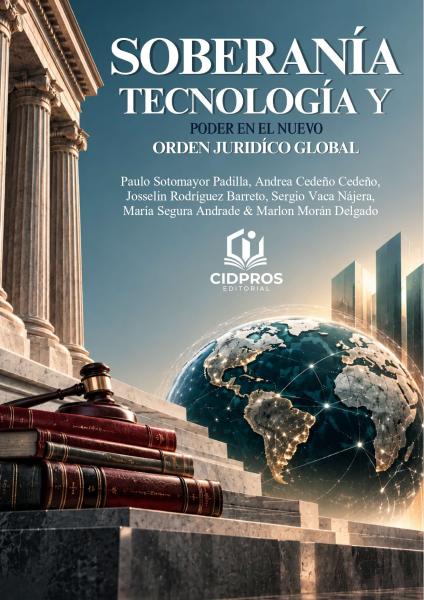
Soberanía, tecnología y poder en el nuevo orden jurídico global analiza la transformación de la autoridad estatal y de las relaciones de poder ante la expansión de tecnologías digitales, infraestructuras transnacionales, plataformas, inteligencia artificial y flujos globales de datos. La obra examina cómo la soberanía deja de depender exclusivamente del territorio y comienza a vincularse con capacidades regulatorias, control de infraestructura, autonomía tecnológica y protección de derechos. A lo largo de seis capítulos se estudian las nuevas formas de dependencia entre Estados, la competencia tecnológica internacional, la geopolítica de los semiconductores, el poder de las grandes corporaciones digitales y los desafíos derivados de la concentración de datos e infraestructura. También se abordan la soberanía digital, la jurisdicción en el ciberespacio, la identidad digital, la responsabilidad jurídica de empresas tecnológicas y la transformación del derecho internacional frente a actividades transfronterizas. El análisis incorpora además la gobernanza global de la inteligencia artificial, el constitucionalismo digital, la fragmentación normativa, la armonización regulatoria y la necesidad de nuevas instituciones capaces de responder a riesgos tecnológicos complejos. La obra propone comprender el nuevo orden jurídico como una estructura interdependiente, plural y dinámica, donde soberanía, innovación, seguridad, derechos fundamentales y cooperación internacional deben articularse sin reducir la autonomía de los Estados ni ampliar de forma desproporcionada el poder tecnológico.
Allen, D., Hubbard, S., Lim, W., Stanger, A., Wagman, S., Zalesne, K., & Omoakhalen, O. (2025). A roadmap for governing AI: Technology governance and power-sharing liberalism. AI and Ethics, 5(3), 3355-3377. https://doi.org/10.1007/s43681-024-00635-y
Beduschi, A. (2021). Rethinking digital identity for post-COVID-19 societies: Data privacy and human rights considerations. Data & Policy, 3, e15. https://doi.org/10.1017/dap.2021.15
Bendiek, A., & Stuerzer, I. (2023). The Brussels effect, European regulatory power and political capital: Evidence for mutually reinforcing internal and external dimensions of the Brussels effect from the European digital policy debate. Digital Society, 2, 5. https://doi.org/10.1007/s44206-022-00031-1
Codagnone, C., & Weigl, L. (2023). Leading the charge on digital regulation: The more, the better, or policy bubble? Digital Society, 2(1), 4. https://doi.org/10.1007/s44206-023-00033-7
Código Orgánico Administrativo. (2017). Segundo Suplemento del Registro Oficial No. 31, 7 de julio de 2017: https://www.gobiernoelectronico.gob.ec/wp-content/uploads/2020/11/COA.pdf
Código Orgánico Integral Penal. (10 de febrero de 2014). Suplemento del Registro Oficial No. 180, 10 de febrero de 2014: https://www.defensa.gob.ec/wp-content/uploads/downloads/2021/03/COIP_act_feb-2021.pdf
Constitución de la República del Ecuador. (2008). Registro Oficial No. 449, 20 de octubre de 2008: https://www.defensa.gob.ec/wp-content/uploads/downloads/2021/02/Constitucion-de-la-Republica-del-Ecuador_act_ene-2021.pdf
David, G. (2024). Artificial intelligence: Opportunities and challenges for public administration. Canadian Public Administration, 67(3), 388-406. https://doi.org/10.1111/capa.12580
Emery-Xu, N., Jordan, R., & Trager, R. (2025). International governance of advancing artificial intelligence. AI & Society, 40(4), 3019-3044. https://doi.org/10.1007/s00146-024-02050-7
Ferrari, F. (2024). State roles in platform governance: AI’s regulatory geographies. Competition & Change, 28(2), 340-358. https://doi.org/10.1177/10245294231218335
Fratini, S., Hine, E., Novelli, C., Roberts, H., & Floridi, L. (2024). Digital sovereignty: A descriptive analysis and a critical evaluation of existing models. Digital Society, 3(3), 59. https://doi.org/10.1007/s44206-024-00146-7
Giannopoulou, A. (2023). Digital identity infrastructures: A critical approach of self-sovereign identity. Digital Society, 2(2), 18. https://doi.org/10.1007/s44206-023-00049-z
Golia, A. (2024). Critique of digital constitutionalism: Deconstruction and reconstruction from a societal perspective. Global Constitutionalism, 13(3), 488-518. https://doi.org/10.1017/S2045381723000126
Gordon, G. (2024). Digital sovereignty, digital infrastructures, and quantum horizons. AI & Society, 39(1), 125-137. https://doi.org/10.1007/s00146-023-01729-7
Hamdani, M., & Belfencha, I. (2024). Strategic implications of the US-China semiconductor rivalry. Discover Global Society, 2, 67. https://doi.org/10.1007/s44282-024-00081-5
Heidebrecht, S. (2024). From market liberalism to public intervention: Digital sovereignty and changing European Union digital single market governance. JCMS: Journal of Common Market Studies, 62(1), 205-223. https://doi.org/10.1111/jcms.13488
Helbing, D., & Ienca, M. (2024). Why converging technologies need converging international regulation. Ethics and Information Technology, 26, 15. https://doi.org/10.1007/s10676-024-09756-8
Johns, F. (2023). Digital humanitarian mapping and the limits of imagination in international law. Law and Critique, 34(3), 341-361. https://doi.org/10.1007/s10978-023-09361-6
Karjalainen, T. (2022). The battle of power: Enforcing data protection law against companies holding data power. Computer Law & Security Review, 47, 105742. https://doi.org/10.1016/j.clsr.2022.105742
Katagiri, N. (2021). Why international law and norms do little in preventing non-state cyber attacks. Journal of Cybersecurity, 7(1), tyab009. https://doi.org/10.1093/cybsec/tyab009
Kausche, K., & Weiss, M. (2025). Platform power and regulatory capture in digital governance. Business and Politics, 27(2), 284-308. https://doi.org/10.1017/bap.2024.33
Lafuente, E., Ács, Z., & Szerb, L. (2024). Analysis of the digital platform economy around the world: A network DEA model for identifying policy priorities. Journal of Small Business Management, 62(2), 847-891. https://doi.org/10.1080/00472778.2022.2100895
Lane, L. (2022). Clarifying human rights standards through artificial intelligence initiatives. International & Comparative Law Quarterly, 71(4), 915-944. https://doi.org/10.1017/S0020589322000380
Leventopoulos, S., Pipyros, K., & Gritzalis, D. (2024). Retaliating against cyber-attacks: A decision-taking framework for policy-makers and enforcers of international and cybersecurity law. International Cybersecurity Law Review, 5(2), 237-262. https://doi.org/10.1365/s43439-024-00113-5
Ley de Comercio Electrónico, Firmas Electrónicas y Mensajes de Datos. (2002). Suplemento del Registro Oficial No. 557, 17 de abril de 2002: https://www.telecomunicaciones.gob.ec/wp-content/uploads/downloads/2012/11/Ley-de-Comercio-Electronico-Firmas-y-Mensajes-de-Datos.pdf
Ley Orgánica de Protección de Datos Personales. (2021). Quinto Suplemento del Registro Oficial No. 459, 26 de mayo de 2021: https://www.finanzaspopulares.gob.ec/wp-content/uploads/2021/07/ley_organica_de_proteccion_de_datos_personales.pdf
Ley Orgánica Reformatoria del Código Orgánico Integral Penal para Prevenir y Combatir la Violencia Sexual Digital y Fortalecer la Lucha contra los Delitos Informáticos. (2021). Cuarto Suplemento del Registro Oficial No. 526, 30 de agosto de 2021: https://www.asambleanacional.gob.ec/sites/default/files/private/asambleanacional/filesasambleanacionalnameuid-29/Leyes%202013-2017/1272-mmonta%C3%B1ov/ro-4s-526-de-30-08-2021.pdf
Lilkov, D. (2023). Technological sovereignty? Delivering a complete European digital single market. European View, 22(2), 176-186. https://doi.org/10.1177/17816858231204745
Mokry, S., & Gurol, J. (2024). Competing ambitions regarding the global governance of artificial intelligence: China, the US, and the EU. Global Policy, 15(5), 955-968. https://doi.org/10.1111/1758-5899.13444
Murcia, M., & Suddaby, R. (2024). A layered governance approach to regulating Big Tech. Long Range Planning, 57(4), 102453. https://doi.org/10.1016/j.lrp.2024.102453
Papageorgiou, M., Can, M., & Vieira, A. (2024). China as a threat and balancing behavior in the realm of emerging technologies. Chinese Political Science Review, 9, 441-482. https://doi.org/10.1007/s41111-024-00248-0
Pollicino, O. (2023). The quadrangular shape of the geometry of digital power(s) and the move towards a procedural digital constitutionalism. European Law Journal, 29(1-2), 10-30. https://doi.org/10.1111/eulj.12472
Quintais, J., de Gregorio, G., & Magalhães, J. (2023). How platforms govern users’ copyright-protected content: Exploring the power of private ordering and its implications. Computer Law & Security Review, 48, 105792. https://doi.org/10.1016/j.clsr.2023.105792
Roberts, H., Cowls, J., Casolari, F., Morley, J., Taddeo, M., & Floridi, L. (2021). Safeguarding European values with digital sovereignty: An analysis of statements and policies. Internet Policy Review, 10(3). https://doi.org/10.14763/2021.3.1575
Roberts, H., Hine, E., Taddeo, M., & Floridi, L. (2024). Global AI governance: Barriers and pathways forward. International Affairs, 100(3), 1275-1286. https://doi.org/10.1093/ia/iiae073
Ruohonen, J. (2021). The treachery of images in the digital sovereignty debate. Minds and Machines, 31(3), 439-456. https://doi.org/10.1007/s11023-021-09566-7
Saura García, C. (2024). Datafeudalism: The domination of modern societies by Big Tech companies. Philosophy & Technology, 37, 90. https://doi.org/10.1007/s13347-024-00777-1
Shurson, J. (2025). Investigative jurisdiction: The evolving limits of extraterritoriality in transnational digital investigations. International & Comparative Law Quarterly, 74(3), 675-705. https://doi.org/10.1017/S0020589325100985
Tallberg, J., Erman, E., Furendal, M., Geith, J., Klamberg, M., & Lundgren, M. (2023). The global governance of artificial intelligence: Next steps for empirical and normative research. International Studies Review, 25(3), viad040. https://doi.org/10.1093/isr/viad040
ten Oever, N., Perarnaud, C., Kristoff, J., Müller, M., Resing, M., Filasto, A., & Kanich, C. (2024). Sanctions and infrastructural ideologies: Assessing the material shaping of EU digital sovereignty in response to the war in Ukraine. Policy & Internet, 16(4), 692-710. https://doi.org/10.1002/poi3.422
Trithara, D. (2024). Agents of platform governance: Analyzing U.S. civil society's role in contesting online content moderation. Telecommunications Policy, 48(4), 102735. https://doi.org/10.1016/j.telpol.2024.102735
von Scherenberg, F., Hellmeier, M., & Otto, B. (2024). Data sovereignty in information systems. Electronic Markets, 34, 15. https://doi.org/10.1007/s12525-024-00693-4

CIDPROS EDITORIAL es una editorial académica comprometida con la difusión ética y responsable del conocimiento científico y con la promoción de publicaciones académicas de calidad.
CC BY 4.0 — Creative Commons Atribución 4.0 Internacional
Esta obra se distribuye bajo los términos de la licencia Creative Commons Atribución 4.0 Internacional (CC BY 4.0), que permite compartir y adaptar el material para cualquier propósito, incluso comercial, siempre que se otorgue el crédito correspondiente a los autores, se proporcione un enlace a la licencia y se indique si se realizaron cambios.