
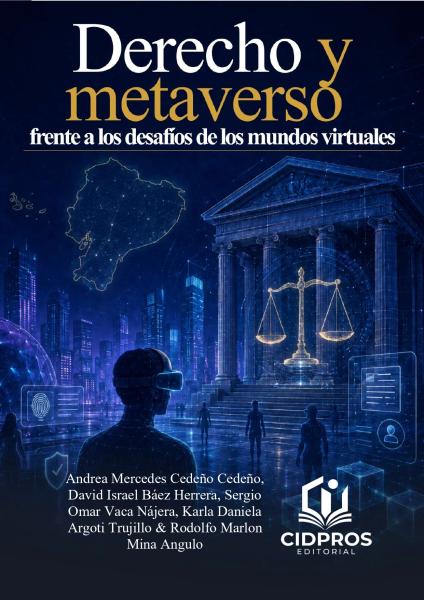
El metaverso representa una nueva etapa en la evolución de los entornos digitales, al integrar realidad virtual y aumentada, avatares, inteligencia artificial, sensores, cadenas de bloques, activos digitales y sistemas automatizados. Estas tecnologías permiten desarrollar actividades sociales, educativas, laborales, comerciales y recreativas dentro de espacios persistentes capaces de producir consecuencias jurídicas más allá de la experiencia virtual.
Esta obra analiza los principales desafíos que el metaverso plantea al derecho, con especial atención al ordenamiento jurídico ecuatoriano. Se examinan la identidad digital, los avatares, la protección de datos personales y biométricos, el consentimiento, la intimidad, la libertad de expresión, la protección de menores, la suplantación de identidad y el hábeas data. Asimismo, se estudian la economía virtual, los bienes digitales, la propiedad de activos, los NFT, los contratos electrónicos e inteligentes, la protección del consumidor, la propiedad intelectual y la tributación de operaciones virtuales.
El libro también aborda la responsabilidad jurídica por daños, la actuación de las plataformas, los delitos cometidos en mundos virtuales, el acoso mediante avatares, el fraude, la ciberseguridad y la evidencia digital. Desde una perspectiva de gobernanza, se analizan la jurisdicción, la cooperación internacional, los derechos humanos, la transparencia algorítmica, la inclusión y la sostenibilidad.
La obra sostiene que el metaverso no constituye un espacio independiente del derecho. Aunque las normas vigentes ofrecen bases para resolver numerosos conflictos, sus características inmersivas, automatizadas y transfronterizas exigen criterios específicos de interpretación, prevención y responsabilidad. Finalmente, se propone una regulación futura para Ecuador basada en riesgos, protección efectiva de derechos, transparencia tecnológica y cooperación institucional.
Al-Busaidi, A. S., Raman, R., Hughes, L., Albashrawi, M. A., Malik, T., Dwivedi, Y. K., . . . Walton, P. (2024). Redefining boundaries in innovation and knowledge domains: Investigating the impact of generative artificial intelligence on copyright and intellectual property rights. Journal of Innovation & Knowledge, 9(4), 100630. https://doi.org/10.1016/j.jik.2024.100630
Alqahtany, S. S., y Syed, T. A. (2024). ForensicTransMonitor: A comprehensive blockchain approach to reinvent digital forensics and evidence management. Information , 15(2), 109. https://doi.org/10.3390/info15020109
Asamblea Constituyente del Ecuador. (20 de octubre de 2008). Constitución de la República del Ecuador. Asamblea Nacional del Ecuador: https://www.defensa.gob.ec/wp-content/uploads/downloads/2021/02/Constitucion-de-la-Republica-del-Ecuador_act_ene-2021.pdf
Asamblea Nacional del Ecuador. (22 de octubre de 2009). Ley Orgánica de Garantías Jurisdiccionales y Control Constitucional. Corte Constitucional del Ecuador: https://www.defensa.gob.ec/wp-content/uploads/downloads/2020/03/Ley-Organica-de-Garantias-Jurisdiccionales-y-Control-Constitucional_act_marzo_2020.pdf
Asamblea Nacional del Ecuador. (10 de febrero de 2014). Código Orgánico Integral Penal. Asamblea Nacional del Ecuador: https://www.defensa.gob.ec/wp-content/uploads/downloads/2021/03/COIP_act_feb-2021.pdf
Asamblea Nacional del Ecuador. (22 de mayo de 2015). Código Orgánico General de Procesos. Consejo de la Judicatura: https://www.telecomunicaciones.gob.ec/wp-content/uploads/2018/09/Codigo-Org%C3%A1nico-General-de-Procesos.pdf
Asamblea Nacional del Ecuador. (26 de mayo de 2021). Ley Orgánica de Protección de Datos Personales. Ministerio de Telecomunicaciones y de la Sociedad de la Información: https://www.finanzaspopulares.gob.ec/wp-content/uploads/2021/07/ley_organica_de_proteccion_de_datos_personales.pdf
Berrezueta, G. S., Daya, R., y Wagner, S. (2025). Virtual reality in sign language education: Opportunities, challenges, and the road ahead. Frontiers in Virtual Reality, 6, 1625910. https://doi.org/10.3389/frvir.2025.1625910
Brenncke, M. (2024). Regulating dark patterns. Notre Dame Journal of International & Comparative Law, 14(1), 39-79. https://scholarship.law.nd.edu/ndjicl/vol14/iss1/5/
Castillo, A. J., Tasic, I., y Cano, M. D. (2024). Enhancing digital identity: Evaluating avatar creation tools and privacy challenges for the metaverse. Information, 15(10), 624. https://doi.org/10.3390/info15100624
Chawki, M., Basu, S., y Choi, K.-S. (2024). Redefiniendo los límites en el metaverso: Navegando los desafíos del daño virtual y la seguridad del usuario. Laws, 13(3), 33. https://doi.org/10.3390/laws13030033
Cheong, B. (2024). Transparency and accountability in AI systems: Safeguarding wellbeing in the age of algorithmic decision-making. Frontiers in Human Dynamics, 6, 1421273. https://doi.org/10.3389/fhumd.2024.1421273
Chow, Y.-W., Susilo, W., Li, Y., Li, N., y Nguyen, C. (2023). Visualization and cybersecurity in the metaverse: A survey. Journal of Imaging, 9(1), 11. https://doi.org/10.3390/jimaging9010011
Conferencia de La Haya de Derecho Internacional Privado. (diciembre de 2024). Private international law aspects of the digital economy: Report. Documento Preliminar núm. 5: https://assets.hcch.net/docs/0d75731a-66a2-496b-b740-bc5503d6be01.pdf?
Congreso Nacional del Ecuador. (10 de julio de 2000). Ley Orgánica de Defensa del Consumidor. Defensoría del Pueblo del Ecuador: https://www.dpe.gob.ec/wp-content/dpetransparencia2012/literala/BaseLegalQueRigeLaInstitucion/LeyOrganicadelConsumidor.pdf
Congreso Nacional del Ecuador. (17 de abril de 2002). Ley de Comercio Electrónico, Firmas Electrónicas y Mensajes de Datos. Ministerio de Telecomunicaciones y de la Sociedad de la Información: https://www.telecomunicaciones.gob.ec/wp-content/uploads/downloads/2012/11/Ley-de-Comercio-Electronico-Firmas-y-Mensajes-de-Datos.pdf
Congreso Nacional del Ecuador. (3 de enero de 2003). Código de la Niñez y Adolescencia. Consejo de la Judicatura: https://www.igualdad.gob.ec/wp-content/uploads/downloads/2017/11/codigo_ninezyadolescencia.pdf
Congreso Nacional del Ecuador. (24 de junio de 2005). Código Civil. Defensoría Pública del Ecuador: https://webhistorico.epn.edu.ec/wp-content/uploads/2015/06/Codigo-Civil1.pdf
Fernandez, C., y Hui, P. (2022). Life, the metaverse and everything: An overview of privacy, ethics, and governance in metaverse. AI and Ethics, 2, 395–404. https://doi.org/10.1109/ICDCSW56584.2022.00058
Fiaz, F., Sajjad, S., Iqbal, Z., Yousaf, M., y Muhammad, Z. (2024). MetaSSI: A framework for personal data protection, enhanced cybersecurity and privacy in metaverse virtual reality platforms. Future Internet, 16(5), 159. https://doi.org/10.3390/fi16050176
Ghazinoory, S., Parvin, F., Saghafi, F., Afshari-Mofrad, M., Ghazavi, N., y Fatemi, M. (2025). Metaverse technology tree: A holistic view. Frontiers in Artificial Intelligence, 8, 1545144. https://doi.org/10.3389/frai.2025.1545144
González, T. M. (2023). Virtual emotions and criminal law. Frontiers in Psychology, 14, 1260425. https://doi.org/10.3389/fpsyg.2023.1260425
Gupta, A., Khan, H., Nazir, S., Shafiq, M., y Shabaz, M. (2023). Metaverse security: Issues, challenges and a viable ZTA model. Electronics, 12(2), 391. https://doi.org/10.3390/electronics12020391
Jauhiainen, J., Krohn, C., y Junnila, J. (2023). Metaverse and sustainability: Systematic review of scientific publications until 2022 and beyond. Sustainability, 15(1), 346. https://doi.org/10.3390/su15010346
Kasiyanto, S., y Kilinc, M. (2022). The legal conundrums of the metaverse. Journal of Central Banking Law and Institutions, 1(2), 299–322. https://doi.org/10.21098/jcli.v1i2.25
Kostenko, O., Furashev, V., Zhuravlov, D., y Dniprov, O. (2022). Genesis of legal regulation web and the model of the electronic jurisdiction of the metaverse. Bratislava Law Review, 6(2), 21–36. https://doi.org/10.46282/blr.2022.6.2.316
Küsters, A. (2026). Trusted but not trustworthy: A conceptual analysis of AI agent risks in the metaverse and EU policy responses. Frontiers in Virtual Reality, 7, 1813331. https://doi.org/10.3389/frvir.2026.1813331
Lazea, G., Balea-Stanciu, M., Bunget, O., Sumănaru, A., y Coraș, A. (2025). Cryptocurrency taxation: A bibliometric analysis and emerging trends. International Journal of Financial Studies, 13(1), 37. https://doi.org/10.3390/ijfs13010037
Madanchian, M., y Taherdoost, H. (2024). Business model evolution in the age of NFTs and the metaverse. Information, 15(7), 378. https://doi.org/10.3390/info15070378
Martínez, L. W., Moreno, B. A., y Ruiz, D. E. (2024). Linking a digital asset to an NFT—Technical and legal analysis. Laws, 13(5), 59. https://doi.org/10.3390/laws13050059
Munn, N., y Weijers, D. (2023). The real ethical problem with metaverses. Frontiers in Human Dynamics, 5, 1226848. https://doi.org/10.3389/fhumd.2023.1226848
Ness, S. (2024). VAT/GST harmonisation challenges for digital assets such as bitcoin and NFTs in the EU following Case C-264/14 (Skatteverket v David Hedqvist). International Cybersecurity Law Review, 5(3), 459–490. https://doi.org/10.1365/s43439-024-00124-2
Papagiannidis, E., Mikalef, P., y Conboy, K. (2025). Responsible artificial intelligence governance: A review and research framework. The Journal of Strategic Information Systems, 34(2), 101885. https://doi.org/10.1016/j.jsis.2024.101885
Peña, A. B., y Rubio, A. F. (2024). Ethical approach to the use of immersive technologies: Advance about digitalisation of multilingual programs in the EHEA. Frontiers in Virtual Reality, 5, 1357595. https://doi.org/10.3389/frvir.2024.1357595
Pooyandeh, M., Han, K. J., Sohn, I., y Stylios, C. (2022). Cybersecurity in the AI-based metaverse: A survey. Applied Sciences, 12(24), 12993. https://doi.org/10.3390/app122412993
Sakka, S., Liagkou, V., y Ferreira, A. (2026). Digital boundaries and consent in the metaverse: A comparative review of privacy risks. Journal of Cybersecurity and Privacy, 6(1), 24. https://doi.org/10.3390/jcp6010024
Santamaría, P., Tobarra, L., Pastor-Vargas, R., y Robles-Gómez, A. (2023). Smart contracts for managing the chain-of-custody of digital evidence: A practical case of study. Smart Cities, 6(2), 709–727. https://doi.org/10.3390/smartcities6020034
Sentencia 001-14-PJO-CC, 0067-11-JD (Corte Constitucional del Ecuador 23 de abril de 2014). http://bivicce.corteconstitucional.gob.ec/local/File/Gaceta_Constitucional/007_Gaceta_Constitucional_no_007_03-07-2014.pdf
Sentencia 182-15-SEP-CC, 1493-10-EP (Corte Constitucional del Ecuador 28 de septiembre de 2015). https://esacc.corteconstitucional.gob.ec/storage/api/v1/10_DWL_FL/eyJjYXJwZXRhIjoicm8iLCJ1dWlkIjoiODhmMGY4ZmQtN2YzNS00Y2FhLTkxOWEtNjhhZjE2MDRmZjA2LnBkZiJ9
Sentencia 2064-14-EP/21, 2064-14-EP (Corte Constitucional del Ecuador 27 de enero de 2021). https://esacc.corteconstitucional.gob.ec/storage/api/v1/10_DWL_FL/eyJjYXJwZXRhIjoidHJhbWl0ZSIsInV1aWQiOiI1MDM5NmI5Ny1hZmFiLTQ1OWEtYWRlMC1jNjdmNzM1NTMzYjAucGRmIn0=
Sentencia 47-19-JD/22, 47-19-JD (Corte Constitucional del Ecuador 21 de diciembre de 2022). https://esacc.corteconstitucional.gob.ec/storage/api/v1/10_DWL_FL/e2NhcnBldGE6J3RyYW1pdGUnLCB1dWlkOic4ZTM4ZGFhOC1hY2NiLTQ0NjktOTcyNy1jZTZjOWIyNzUxNTYucGRmJ30=
Sentencia 59-19-IN/24, 59-19-IN (Corte Constitucional del Ecuador 11 de julio de 2024). https://esacc.corteconstitucional.gob.ec/storage/api/v1/10_DWL_FL/eyJjYXJwZXRhIjoidHJhbWl0ZSIsInV1aWQiOiJjODcwOTNhZS04ZTExLTRjNGQtOTMxOC01ZTc3NDJlOGFiMTYucGRmIn0=
Sentencia 89-19-JD/21, 89-19-JD (Corte Constitucional del Ecuador 20 de julio de 2021). https://esacc.corteconstitucional.gob.ec/storage/api/v1/10_DWL_FL/e2NhcnBldGE6J3RyYW1pdGUnLCB1dWlkOic2MWI1ZDhiMy1iYmE1LTRhN2UtOWZjNS02NzM1ZWFiMzVlNTYucGRmJ30=
Smith, C., Molka-Danielsen, J., Webb-Benjamin, J., y Rasool, J. (2025). The challenges of consent in a decentralised metaverse: Exploring ethically informed protections and standards to safeguard humans. Frontiers in Blockchain, 8, 1471431. https://doi.org/10.3389/frvir.2025.1401073
Song, C., Shin, S., y Shin, K. (2023). Exploring the key characteristics and theoretical framework for research on the metaverse. Applied Sciences, 13(13), 7628. https://doi.org/10.3390/app13137628
Sorrentino, G., y López, G. J. (2025). Rethinking privacy for avatars: Biometric and inferred data in the metaverse. Frontiers in Virtual Reality, 6, 1520655. https://doi.org/10.3389/frvir.2025.1520655
Taherdoost, H. (2023). Smart contracts in blockchain technology: A critical review. Information, 14(2), 117. https://doi.org/10.3390/info14020117
Tukur, M., Schneider, J., Househ, M., Dokoro, A., Ismail, U., Dawaki, M., y Agus, M. (2023). The metaverse digital environments: A scoping review of the challenges, privacy and security issues. Frontiers in Big Data, 6, 1301812. https://doi.org/10.3389/fdata.2023.1301812
Varela, E. C., Toasa, R., y Urdaneta, M. (2025). The use of artificial intelligence in cybercrime: Impact analysis in Ecuador and mitigation strategies. Journal of Cybersecurity and Privacy, 5(4), 100. https://doi.org/10.3390/jcp5040100
Wang, X., Lee, L. H., Bermejo, F. C., y Hui, P. (2024). The Dark Side of Augmented Reality: Exploring Manipulative Designs in AR. International Journal of Human–Computer Interaction, 40(13), 3449-3464. https://doi.org/10.1080/10447318.2023.2188799
Zhu, G., Tang, M., Jian, X., y Mu, T. (2025). A study of government regulation’s strategy for solving the algorithmic black-box puzzle of digital platforms: A complex network-based perspective. Frontiers in Physics, 13, 1538742. https://doi.org/10.3389/fphy.2025.1538742

CIDPROS EDITORIAL es una editorial académica comprometida con la difusión ética y responsable del conocimiento científico y con la promoción de publicaciones académicas de calidad.
CC BY 4.0 — Creative Commons Atribución 4.0 Internacional
Esta obra se distribuye bajo los términos de la licencia Creative Commons Atribución 4.0 Internacional (CC BY 4.0), que permite compartir y adaptar el material para cualquier propósito, incluso comercial, siempre que se otorgue el crédito correspondiente a los autores, se proporcione un enlace a la licencia y se indique si se realizaron cambios.