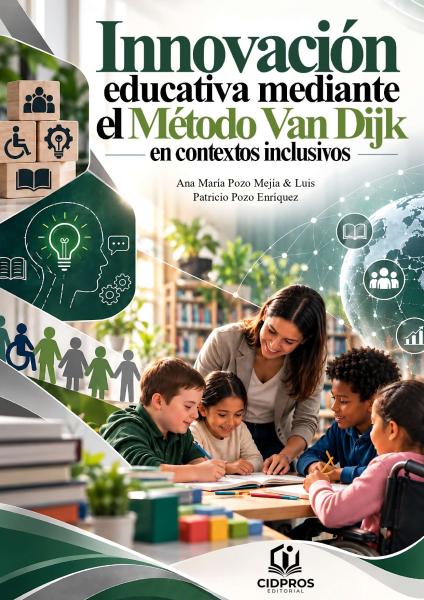
Innovación educativa mediante el Método Van Dijk en contextos inclusivos aborda los fundamentos, estrategias y posibilidades de aplicación de este enfoque educativo en estudiantes con sordoceguera, multidiscapacidad y necesidades complejas de comunicación. La obra analiza el papel del movimiento, el tacto, la interacción y las experiencias compartidas como bases para favorecer procesos comunicativos progresivos y significativos. También examina la comunicación prelingüística, receptiva y expresiva, así como el uso de sistemas alternativos y apoyos adaptados a las características individuales del estudiante. El libro profundiza en estrategias educativas como la resonancia, los movimientos coactivos, la anticipación, las rutinas, la imitación y las actividades significativas orientadas al desarrollo de la autonomía y la participación. Asimismo, aborda la planificación educativa, la adaptación de ambientes, los recursos accesibles, la mediación docente, el trabajo interdisciplinario y la evaluación del progreso comunicativo. Un espacio importante se dedica a la sordoceguera y la multidiscapacidad, sus barreras comunicativas y las formas corporales, táctiles y gestuales de interacción. La obra incorpora además la perspectiva familiar, analizando necesidades de orientación, acompañamiento, coordinación profesional y redes de apoyo. En su conjunto, propone una educación inclusiva centrada en las capacidades, la comunicación, la autonomía y la participación activa del estudiante.
Brittlebank, S., Light, J., & Pope, L. (2024). A scoping review of AAC interventions for children and young adults with simultaneous visual and motor impairments: Clinical and research implications. Augmentative and Alternative Communication, 40(3), 219-237. https://doi.org/10.1080/07434618.2024.2327044
Carrera, K., Baquedano, T., & Herrera, C. (2024). Sordoceguera y sistemas de comunicación: una exploración de sus principales núcleos teóricos. Código Científico Revista de Investigación, 5(1), 1231-1246. https://doi.org/10.55813/gaea/ccri/v5/n1/429
Colonna, T., & Valenti, A. (2024). Comunicare con alunni sordociechi: riflessioni e pratiche pedagogiche. Italian Journal of Special Education for Inclusion, 12(1), 27-34. https://doi.org/10.7346/sipes-01-2024-02
Cruz-Núñez, R., Seminario-Hurtado, N., Avellaneda-Vásquez, J., & Solís-Castillo, J. (2025). Accesibilidad tecnológica de estudiantes universitarios con sordoceguera. Revista de Ciencias Sociales, 31(2), 127-138. https://doi.org/10.31876/rcs.v31i2.43751
Donoso, O., Lattapiat, P., & Olivares, C. (2022). Análisis del trabajo pedagógico realizado por docentes con estudiantes que presentan sordoceguera en cinco regiones de Chile, en escuelas regulares con Programas de Integración Escolar (PIE) y escuelas especiales. Revista Educación, 46(1), 155-170. https://doi.org/10.15517/revedu.v46i1.45087
Erwin-Davidson, L., McKee, A., & O’Crowley, E. (2024). Improving family engagement during implementation of IEP-aided AAC services: An interdisciplinary US-based perspective. Frontiers in Education, 9, 1487304. https://doi.org/10.3389/feduc.2024.1487304
Fonsfria, M., Ferioli, G., Karayannis, Z., & Molina, H. (2022). Análisis fílmico de prácticas educativas en niños con discapacidad múltiple y sordoceguera en América Latina y Caribe. Revista Cedotic, 7(2), 12-41. https://doi.org/10.15648/cedotic.2.2022.3538
Geuze, L., & Goossensen, A. (2021). Exploring the experiences of Dutch parents caring for children with profound intellectual and multiple disabilities: A thematic analysis of their blogs. Global Qualitative Nursing Research, 8, 23333936211028170. https://doi.org/10.1177/23333936211028170
Geuze, L., Goossensen, A., & Schrevel, S. (2023). “Continuously struggling for balance”: The lived experiences of Dutch parents caring for children with profound intellectual and multiple disabilities. Journal of Intellectual & Developmental Disability, 48(2), 161-171. https://doi.org/10.3109/13668250.2022.2073707
Geuze, L., Schrevel, S., & Goossensen, A. (2023). “It is important that we also remain a person ourselves”: A qualitative study about the role of healthcare and social welfare services by Dutch parents caring for a child with profound intellectual and multiple disabilities at home. SSM - Qualitative Research in Health, 4, 100326. https://doi.org/10.1016/j.ssmqr.2023.100326
Gjermestad, A., Skarsaune, S., & Bartlett, R. (2023). Advancing inclusive research with people with profound and multiple learning disabilities through a sensory-dialogical approach. Journal of Intellectual Disabilities, 27(1), 40-53. https://doi.org/10.1177/17446295211062390
Haakma, I., de Boer, A., van Esch, S., Minnaert, A., & van der Putten, A. (2021). Inclusion moments for students with profound intellectual and multiple disabilities in mainstream schools: The teacher assistant’s role in supporting peer interactions. European Journal of Special Needs Education, 36(2), 231-247. https://doi.org/10.1080/08856257.2021.1901374
Heras Figueroa, K., Conce Zaruma, M., Gualoto Meza, A., & Guartán Soria, B. (2025). Inclusión educativa y apoyos a la discapacidad múltiple: una revisión de la literatura desde la educación especial. Revista Multidisciplinaria Investigación Contemporánea, 3(3 especial), 76-105. https://doi.org/10.58995/redlic.rmic.v3.n3.a167
Iacono, T., Goldbart, J., Douglas, S., & Garcia-Melgar, A. (2022). A scoping review and appraisal of AAC research in inclusive school settings. Journal of Developmental and Physical Disabilities, 34, 963-985. https://doi.org/10.1007/s10882-022-09835-y
Ibrahim, S., Clarke, M., Vasalou, A., & Bezemer, J. (2024). Common ground in AAC: How children who use AAC and teaching staff shape interaction in the multimodal classroom. Augmentative and Alternative Communication, 40(2), 74-85. https://doi.org/10.1080/07434618.2023.2283853
Iwasaki, S., Bartlett, M., Willoughby, L., & Manns, H. (2022). Handling turn transitions in Australian tactile signed conversations. Research on Language and Social Interaction, 55(3), 222-240. https://doi.org/10.1080/08351813.2022.2101293
Johnels, L., Wilder, J., & Vehmas, S. (2024). MultiSensory Music Drama with a student with severe/profound intellectual and multiple disabilities: A case study of teacher–researcher co-production. Journal of Research in Special Educational Needs, 24(3), 530-541. https://doi.org/10.1111/1471-3802.12649
Keeley, C., & Bernasconi, T. (2023). Digital participation and digital education for people with profound and multiple disabilities and complex communication needs. Frontiers in Communication, 8, 1229384. https://doi.org/10.3389/fcomm.2023.1229384
Kruithof, K., IJzerman, L., Nieuwenhuijse, A., Huisman, S., Schippers, A., Willems, D., & Olsman, E. (2021). Siblings’ and parents’ perspectives on the future care for their family member with profound intellectual and multiple disabilities: A qualitative study. Journal of Intellectual & Developmental Disability, 46(4), 351-361. https://doi.org/10.3109/13668250.2021.1892261
Kúld, P., Frielink, N., Schuengel, C., & Embregts, P. (2026). Advantages and disadvantages of self-determination support strategies for people with severe or profound intellectual and multiple disabilities: A Delphi study. PLOS ONE, 21(5), e0349403. https://doi.org/10.1371/journal.pone.0349403
Lahaije, S., Luijkx, J., Waninge, A., & van der Putten, A. (2024). Support needs of families with a child with profound intellectual and multiple disabilities. International Journal of Developmental Disabilities, 70(7), 1184-1197. https://doi.org/10.1080/20473869.2023.2168718
Lancioni, G., Singh, N., O’Reilly, M., Sigafoos, J., Alberti, G., Troccoli, O., . . . Ricci, C. (2023). Enabling people with intellectual and other disabilities to make verbal requests using cardboard chips with mini objects or pictures and a smartphone. Frontiers in Rehabilitation Sciences, 4, 1257493. https://doi.org/10.3389/fresc.2023.1257493
Malpartida Repetto, J., & Menzala Peralta, C. (2024). Estimulación multisensorial en sala snoezelen para la integración sensorial de estudiantes con discapacidad en un CEBE de Huánuco (Perú), 2023. Desde el Sur, 16(1), e0015. https://doi.org/10.21142/des-1601-2024-0015
Masuku, K., Khumalo, G., & Moroe, N. (2024). Barriers and facilitators to inclusive education for learners who are deafblind: A scoping review. Education Sciences, 14(10), 1072. https://doi.org/10.3390/educsci14101072
Moreno-Civantos, A., Peinado-Rodríguez, M., & Sánchez-Miranda, M. (2026). Formación e investigación en comunicación aumentativa y alternativa para una práctica inclusiva. Afluir(Extraordinario V), 141-156. https://doi.org/10.48260/ralf.extra5.227
Nakamura, Y. (2023). Action research on education for children with deafblindness. Journal of Special Education Research, 12(1), 5-11. https://doi.org/10.6033/specialeducation.21-S025
Papazafiri, M., & Argyropoulos, V. (2025). Investigating potential tactile strategies of students with deafblindness: An exploratory study. Journal of Research in Special Educational Needs, 25(3), 590-602. https://doi.org/10.1111/1471-3802.12746
Raanes, E., & Berge, S. (2021). Intersubjective understanding in interpreted table conversations for deafblind persons. Scandinavian Journal of Disability Research, 23(1), 260-271. https://doi.org/10.16993/sjdr.786
Rangel-Rodríguez, G., Badia, M., & Blanch, S. (2021). Encouraging emotional conversations in children with complex communication needs: An observational case study. Frontiers in Psychology, 12, 674755. https://doi.org/10.3389/fpsyg.2021.674755
Rendoth, T., Duncan, J., & Foggett, J. (2022). Inclusive curricula for students with severe intellectual disabilities or profound and multiple learning difficulties: A scoping review. Journal of Research in Special Educational Needs, 22(1), 76-88. https://doi.org/10.1111/1471-3802.12544
Rensfeldt Flink, A., Wallin, S., Larsson, J., & Åsberg Johnels, J. (2022). Following children with severe or profound intellectual and multiple disabilities and their mothers through a communication intervention: Single-case mixed-methods findings. International Journal of Developmental Disabilities, 869-887. https://doi.org/10.1080/20473869.2022.2031778
Rensfeldt Flink, A., Wallin, S., Larsson, J., Westling, E., & Åsberg Johnels, J. (2025). School staff perspectives on using augmentative and alternative communication with students with severe or profound intellectual and multiple disabilities. Journal of Research in Special Educational Needs, 25(3), 500-513. https://doi.org/10.1111/1471-3802.12742
Rorije, M., Damen, S., Janssen, M., & Minnaert, A. (2025). Implementation fidelity of video-feedback coaching for communication partners of individuals with congenital deafblindness. International Journal of Educational Research Open, 8, 100428. https://doi.org/10.1016/j.ijedro.2024.100428
Sundqvist, A.-S., Wahlqvist, M., Anderzén-Carlsson, A., & Olsson, E. (2023). Interventions for children with deafblindness—An integrative review. Child: Care, Health and Development, 49(3), 407-430. https://doi.org/10.1111/cch.13060
Valles González, B., Martínez, C., & Sastre, C. (2025). Fonoaudiología y Sordoceguera: un análisis fenomenológico de los roles del fonoaudiólogo en la atención de la persona sordociega. Educación, Arte, Comunicación: Revista Académica e Investigativa, 14(1), 77-93. https://doi.org/10.54753/eac.v14i1.2350
van Alphen, H., Waninge, A., Minnaert, A., & van der Putten, A. (2021). Development and process evaluation of a motor activity program for people with profound intellectual and multiple disabilities. BMC Health Services Research, 21, 259. https://doi.org/10.1186/s12913-021-06264-z
Villwock, A., & Grin, K. (2022). Somatosensory processing in deaf and deafblind individuals: How does the brain adapt as a function of sensory and linguistic experience? A critical review. Frontiers in Psychology, 13, 938842. https://doi.org/10.3389/fpsyg.2022.938842
Ware, J., Buell, S., Chadwick, D., Bradshaw, J., & Goldbart, J. (2024). A systematic review of research on staff training as an intervention to develop communication in children and adults with profound intellectual and multiple disabilities. Journal of Applied Research in Intellectual Disabilities, 37(2), e13201. https://doi.org/10.1111/jar.13201
Wolthuis, K., Bol, G., Minnaert, A., & Janssen, M. (2021). Analysis of the relationship between the content and effectiveness of an intervention based on the Layered Communication Model to improve communication. Journal of Deafblind Studies on Communication, 7(1), 43-79. https://doi.org/10.21827/jdbsc.7.37408
Wu, J., & Xie, Y. (2022). Augmentative and alternative communication in the context of dramatic storytelling: A single-case study of a pre-schooler with a cochlear implant. Frontiers in Education, 7, 806665. https://doi.org/10.3389/feduc.2022.806665
Yoshimoto, M., & Sashima, T. (2024). Relationship between developmental stage of congenitally deaf-blind children and instruction in communication: Interviews with teachers. The Japanese Journal of Special Education, 61(4), 181-190. https://doi.org/10.6033/tokkyou.22A025

CIDPROS EDITORIAL es una editorial académica comprometida con la difusión ética y responsable del conocimiento científico y con la promoción de publicaciones académicas de calidad.
CC BY 4.0 — Creative Commons Atribución 4.0 Internacional
Esta obra se distribuye bajo los términos de la licencia Creative Commons Atribución 4.0 Internacional (CC BY 4.0), que permite compartir y adaptar el material para cualquier propósito, incluso comercial, siempre que se otorgue el crédito correspondiente a los autores, se proporcione un enlace a la licencia y se indique si se realizaron cambios.