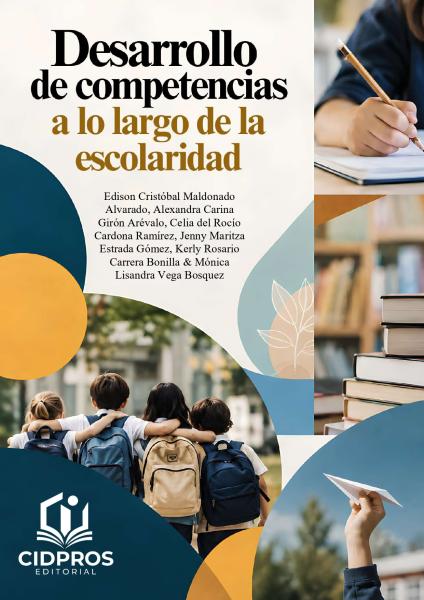
La presente obra analiza el desarrollo progresivo de competencias a lo largo de la escolaridad, desde la primera infancia hasta el Bachillerato, considerando las capacidades que permiten a los estudiantes desenvolverse de manera autónoma, crítica y responsable en distintos contextos. El libro aborda inicialmente competencias vinculadas con autonomía, comunicación, pensamiento lógico, motricidad, convivencia y juego. Posteriormente examina el fortalecimiento de la lectura, escritura, razonamiento matemático, indagación científica, comprensión social y pensamiento ambiental durante la Educación Básica. En niveles superiores se profundiza en pensamiento crítico, argumentación, alfabetización digital, resolución de problemas, búsqueda de información y ciudadanía digital. Asimismo, se analizan competencias académicas y profesionales relacionadas con autorregulación, investigación, orientación académica, empleabilidad y proyecto de vida en Bachillerato. Finalmente, se estudian competencias docentes necesarias para planificar, evaluar, innovar, atender la diversidad e integrar tecnologías de manera pedagógica. La obra propone una visión articulada del aprendizaje, destacando la continuidad entre etapas educativas y la necesidad de diseñar experiencias que permitan movilizar conocimientos, habilidades y actitudes ante situaciones reales. Su enfoque busca contribuir a una educación integral orientada al desarrollo progresivo de capacidades para aprender, participar, adaptarse y tomar decisiones fundamentadas.
Adamuz, N., Fernández, E., García, T., y Montejo, J. (2021). Developing Number Sense: An Approach to Initiate Algebraic Thinking in Primary Education. Mathematics, 9(5), 518. https://doi.org/10.3390/math9050518
Alfayez, M., Aladwan, S., y Shaheen, H. (2022). The Effect of a Training Program Based on Mathematical Problem-Solving Strategies on Critical Thinking Among Seventh-Grade Students. Frontiers in Education, 7, 870524. https://doi.org/10.3389/feduc.2022.870524
Arrimada, M., Torrance, M., y Fidalgo, R. (2022). Response to Intervention in first-grade writing instruction: a large-scale feasibility study. Reading and Writing, 35(4), 943-969. https://doi.org/10.1007/s11145-021-10211-z
Atitsogbe, K., Samson, A., Sarazin-Frey-Pépin, É., El Hamdany, Y., y McCrindle, C. (2026). The influence of career indecision on life satisfaction among grade 12 Ontario students: career choice support as mediator and moderator. International Journal for Educational and Vocational Guidance, 26, 79-103. https://doi.org/10.1007/s10775-024-09717-z
Badau, A., y Trifan, I. (2022). Promote Positive Behaviors in Preschoolers by Implementing an Innovative Educational Program for the Training and Development of Social and Emotional Skills (DeCo–S.E.). International Journal of Environmental Research and Public Health, 19(22), 14931. https://doi.org/10.3390/ijerph192214931
Baker, J., DeLiema, D., Hufnagle, A., Carlson, S., Sharratt, A., y Ridge, S. (2022). Impasses in the wild: Autonomy support in naturalistic, parent-child outdoor play. Frontiers in Education, 7, 885231. https://doi.org/10.3389/feduc.2022.885231
Bickham, D., Moukalled, S., Inyart, H., y Zlokower, R. (2021). Evaluating a Middle-School Digital Citizenship Curriculum (Screenshots): Quasi-Experimental Study. JMIR Mental Health, 8(9), e26197. https://doi.org/10.2196/26197
Cheong, C.-M., Zhu, X., y Xu, W. (2021). Source-Based Argumentation as a Form of Sustainable Academic Skill: An Exploratory Study Comparing Secondary School Students’ L1 and L2 Writing. Sustainability, 13(22), 12869. https://doi.org/10.3390/su132212869
El Majidi, A., Janssen, D., y de Graaff, R. (2021). The effects of in-class debates on argumentation skills in second language education. System, 101, 102576. https://doi.org/10.1016/j.system.2021.102576
Fernández, J., Montenegro, M., y Fernández, J. (2022). Are primary education teachers trained for the use of the technology with disabled students? Research and Practice in Technology Enhanced Learning, 17, 19. https://doi.org/10.1186/s41039-022-00195-x
García, R., Pérez, F., Tomás, J., y Sancho, P. (2023). Effects of self-regulated learning and procrastination on academic stress, subjective well-being, and academic achievement in secondary education. Current Psychology, 42, 26602-26616. https://doi.org/10.1007/s12144-022-03759-8
Herrero, E., y La-Rosa, L. (2022). Los estudiantes de secundaria y la alfabetización mediática en la era de la desinformación. Comunicar, 30(73), 95-106. https://doi.org/10.3916/C73-2022-08
Juliasz, P. (2022). Geography for Children: Drawing and Spatial Thinking. Journal of Geography Education, 49(4), 197-210. https://doi.org/10.18452/25366
Kaitera, S., y Harmoinen, S. (2022). Developing mathematical problem-solving skills in primary school by using visual representations on heuristics. LUMAT: International Journal on Math, Science and Technology Education, 10(2), 111-146. https://doi.org/10.31129/LUMAT.10.2.1696
Kim, D., Park, H.-R., y Vorobel, O. (2024). Enriching Middle School Students’ Learning Through Digital Storytelling: A Multimodal Analytical Framework. ECNU Review of Education, 7(2), 357-383. https://doi.org/10.1177/20965311231182159
König, J., Krepf, M., Bremerich-Vos, A., y Buchholtz, C. (2021). Meeting Cognitive Demands of Lesson Planning: Introducing the CODE-PLAN Model to Describe and Analyze Teachers’ Planning Competence. The Teacher Educator, 56(4), 466-487. https://doi.org/10.1080/08878730.2021.1938324
Korukluoğlu, P., Çeliköz, M., y Gürol, M. (2022). Investigating the Effectiveness of Web 2.0-Based Critical Thinking Curriculum Developed for Secondary School Students: A Mixed-Methods Study. Journal of Learning and Teaching in Digital Age, 7(2), 175-191. https://doi.org/10.53850/joltida.1033373
Kuzle, A. (2023). Elementary school children’s perceptions of geometry classroom as a psychosocial learning environment: an analysis of participant-produced drawings. Learning Environments Research, 26, 379-399. https://doi.org/10.1007/s10984-022-09430-0
López, M., y Jiménez, M. (2022). The Voices of Primary School Boys and Girls on Human Rights and Their Historical Agency. Frontiers in Education, 7, 866801. https://doi.org/10.3389/feduc.2022.866801
Ludewig, U., Hübner, N., y Schroeder, S. (2023). Vocabulary, text coverage, word frequency and the lexical threshold in elementary school reading comprehension. Reading and Writing, 36, 2409-2431. https://doi.org/10.1007/s11145-022-10385-0
Martínez, M., Gómez, C., y Miralles, P. (2021). The effects of a gamified project based on historical thinking on the academic performance of primary school children. Humanities and Social Sciences Communications, 8, 122. https://doi.org/10.1057/s41599-021-00796-9
Massonnie, J., Llaurado, A., Sumner, E., y Dockrell, J. (2022). Oral language at school entry: dimensionality of speaking and listening skills. Oxford Review of Education, 48(6), 743-766. https://doi.org/10.1080/03054985.2021.2013189
Mera, C., Delgado, C., Aragón, E., Menacho, I., Canto, M., y Navarro, J. (2022). Contributions of the psychology of mathematical cognition in early childhood education using apps. Frontiers in Psychology, 13, 913970. https://doi.org/10.3389/fpsyg.2022.913970
Michael, K., Alemu, M., Desie, Y., Atnafu, M., Assefa, S., Regassa, C., . . . Abate, A. (2023). Understanding and practice of active learning among upper primary school science and mathematics teachers. Heliyon, 9(6), e16854. https://doi.org/10.1016/j.heliyon.2023.e16854
Moreira, M., Veiga, G., Lopes, F., Hales, D., Luz, C., y Cordovil, R. (2023). Kindergarten Affordances for Physical Activity and Preschoolers’ Motor and Social-Emotional Competence. Children, 10(2), 214. https://doi.org/10.3390/children10020214
Muslu, N., y Siegel, M. (2024). Feedback Through Digital Application Affordances and Teacher Practice. Journal of Science Education and Technology, 33(5), 729-745. https://doi.org/10.1007/s10956-024-10117-9
Neuenschwander, M., y Hofmann, J. (2022). Career Decision, Work Adjustment, and Person–Job Fit of Adolescents: Moderating Effects of Parental Support. Journal of Career Development, 49(1), 76-89. https://doi.org/10.1177/0894845321995960
Owusu, A., y Owusu, K. (2023). Assessing Ghanaian primary school pupils’ scientific reasoning skills. Eurasian Journal of Science and Environmental Education, 3(2), 99-107. https://doi.org/10.30935/ejsee/13886
Pedaste, M., Baucal, A., y Reisenbuk, E. (2021). Towards a science inquiry test in primary education: development of items and scales. International Journal of STEM Education, 8, 19. https://doi.org/10.1186/s40594-021-00278-z
Rivero, M., Vilaseca, R., Cantero, M., Valls, C., y Leiva, D. (2023). Relations between Positive Parenting Behavior during Play and Child Language Development at Early Ages. Children, 10(3), 505. https://doi.org/10.3390/children10030505
Sando, O., Sandseter, E., y Brussoni, M. (2023). The Role of Play and Objects in Children’s Deep-Level Learning in Early Childhood Education. Education Sciences, 13(7), 701. https://doi.org/10.3390/educsci13070701
Santagata, R., Villavicencio, A., Wegemer, C., Cawelti, L., y Gatlin-Nash, B. (2024). “I have been pushed outside of my comfort zone and have grown as a result”: Teacher professional learning and innovation during the pandemic. Journal of Educational Change, 25(4), 699-726. https://doi.org/10.1007/s10833-023-09491-9
Sulistiobudi, R., y Kadiyono, A. (2023). Employability of students in vocational secondary school: Role of psychological capital and student-parent career congruences. Heliyon, 9(2), e13214. https://doi.org/10.1016/j.heliyon.2023.e13214
Svobodová, S., y Kroufek, R. (2022). Environmental Literacy of ISCED 2 Pupils in the Czech Republic and Slovakia. European Journal of Science and Mathematics Education, 10(4), 519-528. https://doi.org/10.30935/scimath/12361
Woodcock, S., Sharma, U., Subban, P., y Hitches, E. (2022). Teacher self-efficacy and inclusive education practices: Rethinking teachers’ engagement with inclusive practices. Teaching and Teacher Education, 117, 103802. https://doi.org/10.1016/j.tate.2022.103802
Wu, B., Hu, Y., Yu, X., Sun, M., Xie, H., Li, Z., y Wang, M. (2023). How do secondary students engage in complex problem-solving processes in a STEM project? Knowledge Management & E-Learning, 15(4), 506-522. https://doi.org/10.34105/j.kmel.2023.15.029
CIDPROS EDITORIAL es una editorial académica comprometida con la difusión ética y responsable del conocimiento científico y con la promoción de publicaciones académicas de calidad.
CC BY 4.0 — Creative Commons Atribución 4.0 Internacional
Esta obra se distribuye bajo los términos de la licencia Creative Commons Atribución 4.0 Internacional (CC BY 4.0), que permite compartir y adaptar el material para cualquier propósito, incluso comercial, siempre que se otorgue el crédito correspondiente a los autores, se proporcione un enlace a la licencia y se indique si se realizaron cambios.