
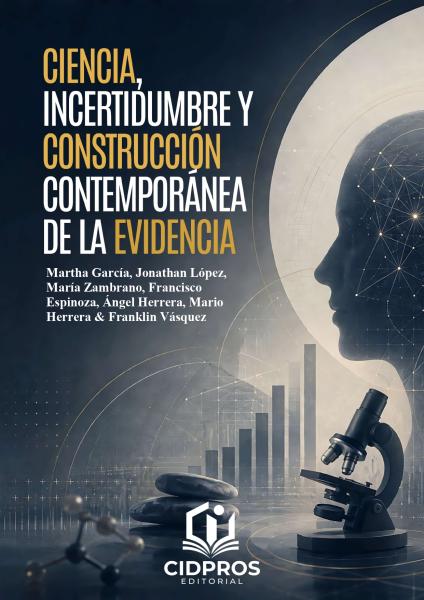
Ciencia, incertidumbre y construcción contemporánea de la evidencia examina las condiciones mediante las cuales el conocimiento científico se produce, evalúa y utiliza en escenarios donde la certeza absoluta no siempre es posible. La obra analiza la incertidumbre como un componente inherente de la investigación y diferencia sus principales manifestaciones, entre ellas el error, la variabilidad, la indeterminación y los límites epistemológicos. A partir de esta base, profundiza en la naturaleza de la evidencia, su relación con la observación y los datos, así como en los criterios empleados para valorar su calidad, consistencia y capacidad justificativa. El libro aborda además los procesos inferenciales que permiten construir generalizaciones, contrastar hipótesis y formular explicaciones, junto con los desafíos asociados con resultados contradictorios, reproducibilidad, replicación y sesgos. También estudia el impacto de los datos masivos, los modelos computacionales, la inteligencia artificial y las simulaciones en la producción contemporánea de evidencia científica. Finalmente, analiza la toma de decisiones bajo información incompleta, la comunicación de riesgos, el principio de precaución y la responsabilidad vinculada con la interpretación y aplicación de resultados. La propuesta integra perspectivas metodológicas, epistemológicas y tecnológicas para comprender cómo gestionar la incertidumbre sin debilitar el rigor científico.
Arias Valencia, M. (2022). Principles, scope, and limitations of the methodological triangulation. Investigación y Educación en Enfermería, 40(2), e03. https://doi.org/10.17533/udea.iee.v40n2e03
Aven, T. (2023). A risk and safety science perspective on the precautionary principle. Safety Science, 165, 106211. https://doi.org/10.1016/j.ssci.2023.106211
Botta, N., Brede, N., Crucifix, M., Ionescu, C., Jansson, P., Li, Z., . . . Richter, T. (2023). Responsibility under uncertainty: Which climate decisions matter most? Environmental Modeling & Assessment, 28, 337-365. https://doi.org/10.1007/s10666-022-09867-w
Burrows, T. (2023). Reproducibility, verifiability, and computational historical research. International Journal of Digital Humanities, 5, 283-298. https://doi.org/10.1007/s42803-023-00068-9
Casula, M., Rangarajan, N., & Shields, P. (2021). The potential of working hypotheses for deductive exploratory research. Quality & Quantity, 55(5), 1703-1725. https://doi.org/10.1007/s11135-020-01072-9
Chen, Y.-C., Jordan, M., Park, J., & Starrett, E. (2024). Navigating student uncertainty for productive struggle: Establishing the importance for and distinguishing types, sources, and desirability of scientific uncertainties. Science Education, 108(4), 1099-1133. https://doi.org/10.1002/sce.21864
Covitt, B., & Anderson, C. (2022). Untangling trustworthiness and uncertainty in science. Science & Education, 31(5), 1155-1180. https://doi.org/10.1007/s11191-022-00322-6
Cox, M., & O’Hagan, A. (2022). Meaningful expression of uncertainty in measurement. Accreditation and Quality Assurance, 27(1), 19-37. https://doi.org/10.1007/s00769-021-01485-5
de la Torre-López, J., Ramírez, A., & Romero, J. (2023). Artificial intelligence to automate the systematic review of scientific literature. Computing, 105, 2171-2194. https://doi.org/10.1007/s00607-023-01181-x
Derksen, M., & Morawski, J. (2022). Kinds of replication: Examining the meanings of “conceptual replication” and “direct replication”. Perspectives on Psychological Science, 17(5), 1490-1505. https://doi.org/10.1177/17456916211041116
Duschl, R., Avraamidou, L., & Azevedo, N. (2021). Data-texts in the sciences: The evidence-explanation continuum. Science & Education, 30(5), 1159-1181. https://doi.org/10.1007/s11191-021-00225-y
Engelschalt, P., Röske, M., Penzlin, J., Krüger, D., & Upmeier zu Belzen, A. (2023). Abductive reasoning in modeling biological phenomena as complex systems. Frontiers in Education, 8, 1170967. https://doi.org/10.3389/feduc.2023.1170967
Fajardo-Fontiveros, O., Reichardt, I., De Los Ríos, H., Duch, J., Sales-Pardo, M., & Guimerà, R. (2023). Fundamental limits to learning closed-form mathematical models from data. Nature Communications, 14, 1043. https://doi.org/10.1038/s41467-023-36657-z
Gough, D. (2021). Appraising evidence claims. Review of Research in Education, 45(1), 1-26. https://doi.org/10.3102/0091732X20985072
Hansen, J., & Quinon, P. (2023). The importance of expert knowledge in big data and machine learning. Synthese, 201, 35. https://doi.org/10.1007/s11229-023-04041-5
Helliwell, J., & Massera, C. (2022). The four Rs and crystal structure analysis: Reliability, reproducibility, replicability and reusability. Journal of Applied Crystallography, 55(5), 1351-1358. https://doi.org/10.1107/S1600576722007208
Hudson, R. (2021). Should we strive to make science bias-free? A philosophical assessment of the reproducibility crisis. Journal for General Philosophy of Science, 52(3), 389-405. https://doi.org/10.1007/s10838-020-09548-w
Jack, S., Orr, E., Campbell, K., Whitmore, C., & Cammer, A. (2023). A framework for selecting data generation strategies in qualitative health research studies. Journal of Human Nutrition and Dietetics, 36(4), 1480-1495. https://doi.org/10.1111/jhn.13134
Kapoor, S., & Narayanan, A. (2023). Leakage and the reproducibility crisis in machine-learning-based science. Patterns, 4(9), 100804. https://doi.org/10.1016/j.patter.2023.100804
Kiyasseh, D., Cohen, A., Jiang, C., & Altieri, N. (2024). A framework for evaluating clinical artificial intelligence systems without ground-truth annotations. Nature Communications, 15, 1808. https://doi.org/10.1038/s41467-024-46000-9
Lee, J., Hwang, E., & Kacker, R. (2022). True value, error, and measurement uncertainty: Two views. Accreditation and Quality Assurance, 27(4), 235-242. https://doi.org/10.1007/s00769-022-01508-9
Leins, D., Haase, S., Eslami, M., Schrier, J., & Freeman, J. (2023). Collaborative methods to enhance reproducibility and accelerate discovery. Digital Discovery, 2(1), 12-27. https://doi.org/10.1039/D2DD00061J
Mathur, M., & Fox, M. (2023). Toward open and reproducible epidemiology. American Journal of Epidemiology, 192(4), 658-664. https://doi.org/10.1093/aje/kwad007
Metzen, H. (2024). Objectivity, shared values, and trust. Synthese, 203, 60. https://doi.org/10.1007/s11229-024-04493-3
Monti, C., Pangallo, M., De Francisci Morales, G., & Bonchi, F. (2023). On learning agent-based models from data. Scientific Reports, 13, 9268. https://doi.org/10.1038/s41598-023-35536-3
Nilsson, A., Peters, J., Meimetis, N., Bryson, B., & Lauffenburger, D. (2022). Artificial neural networks enable genome-scale simulations of intracellular signaling. Nature Communications, 13, 3069. https://doi.org/10.1038/s41467-022-30684-y
Olaghere, A., Wilson, D., & Kimbrell, C. (2023). Inclusive critical appraisal of qualitative and quantitative findings in evidence synthesis. Research Synthesis Methods, 14(6), 847-852. https://doi.org/10.1002/jrsm.1659
Omerovic, E. (2023). Can contradictory results from RCTs that tested the same hypothesis be true simultaneously? Analyses of the VALIDATE-SWEDEHEART and BRIGHT-4 trials. EuroIntervention, 19(10), e802-e805. https://doi.org/10.4244/EIJ-D-23-00151
Pedder, H., Dias, S., Boucher, M., Bennetts, M., Mawdsley, D., & Welton, N. (2022). Methods to assess evidence consistency in dose-response model based network meta-analysis. Statistics in Medicine, 41(4), 625-644. https://doi.org/10.1002/sim.9270
Queirós, P. (2022). Evidencias científicas y conocimiento disciplinar de enfermería. Cultura de los Cuidados, 26(62), 279-293. https://doi.org/10.14198/cuid.2022.62.19
Rickinson, M., Cirkony, C., Walsh, L., Gleeson, J., Salisbury, M., & Boaz, A. (2021). Insights from a cross-sector review on how to conceptualise the quality of use of research evidence. Humanities and Social Sciences Communications, 8, 170. https://doi.org/10.1057/s41599-021-00821-x
Schnarr, A., & Mertz, M. (2022). States of uncertainty, risk–benefit assessment and early clinical research: A conceptual investigation. Science and Engineering Ethics, 28(6), 68. https://doi.org/10.1007/s11948-022-00418-w
Schneider, C., Freeman, A., Spiegelhalter, D., & van der Linden, S. (2022). The effects of communicating scientific uncertainty on trust and decision making in a public health context. Judgment and Decision Making, 17(4), 849-882. https://doi.org/10.1017/S1930297500008962
Selva, J., Argyroudis, S., Cotton, F., Esposito, S., Iqbal, S., Lorito, S., . . . Giardini, D. (2024). A novel multiple-expert protocol to manage uncertainty and subjective choices in probabilistic single and multi-hazard risk analyses. International Journal of Disaster Risk Reduction, 110, 104641. https://doi.org/10.1016/j.ijdrr.2024.104641
Sondhi, A., Segal, B., Snider, J., Humblet, O., & McCusker, M. (2021). Bayesian additional evidence for decision making under small sample uncertainty. BMC Medical Research Methodology, 21, 221. https://doi.org/10.1186/s12874-021-01432-5
Villalobos Antúnez, J., Severino-González, P., Caldera Ynfante, J., & Ramírez-Molina, R. (2023). Epistemología, complejidad y sistema: Una mirada a la incertidumbre en contextos tecnológicos. Revista Científica Saperes Universitas, 6(2), 145-160. https://doi.org/10.53485/rsu.v6i2.346
Ward, Z., & Creel, K. (2024). To hedge or not to hedge: Scientific claims and public justification. Philosophy of Science, 91(4), 990-1008. https://doi.org/10.1017/psa.2024.17
Wei, Z., Yang, A., Rocha, L., Miranda, M., & Nathoo, F. (2022). A review of Bayesian hypothesis testing and its practical implementations. Entropy, 24(2), 161. https://doi.org/10.3390/e24020161
Wiedemann, P., Boerner, F., & Freudenstein, F. (2021). Effects of communicating uncertainty descriptions in hazard identification, risk characterization, and risk protection. PLOS ONE, 16(7), e0253762. https://doi.org/10.1371/journal.pone.0253762
Williamson, J. (2023). Direct inference and probabilistic accounts of induction. Journal for General Philosophy of Science, 54(3), 451-472. https://doi.org/10.1007/s10838-021-09584-0
Woensdregt, M., Fusaroli, R., Rich, P., Modrák, M., Kolokolova, A., Wright, C., & Warlaumont, A. (2024). Lessons for theory from scientific domains where evidence is sparse or indirect. Computational Brain & Behavior, 7(4), 588-607. https://doi.org/10.1007/s42113-024-00214-8

CIDPROS EDITORIAL es una editorial académica comprometida con la difusión ética y responsable del conocimiento científico y con la promoción de publicaciones académicas de calidad.
CC BY 4.0 — Creative Commons Atribución 4.0 Internacional
Esta obra se distribuye bajo los términos de la licencia Creative Commons Atribución 4.0 Internacional (CC BY 4.0), que permite compartir y adaptar el material para cualquier propósito, incluso comercial, siempre que se otorgue el crédito correspondiente a los autores, se proporcione un enlace a la licencia y se indique si se realizaron cambios.