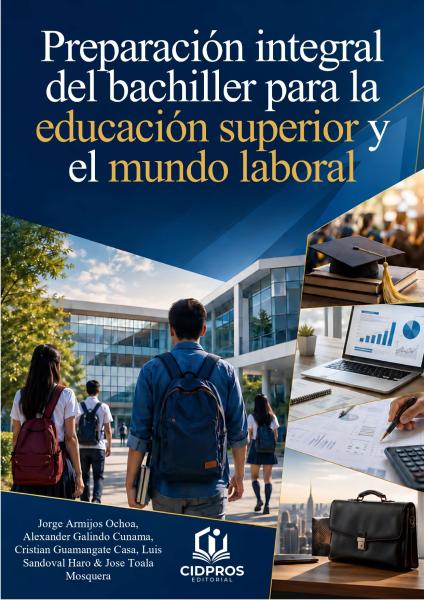
Preparación integral del bachiller para la educación superior y el mundo laboral analiza los principales desafíos que enfrentan los jóvenes al concluir la educación secundaria y comenzar una etapa marcada por decisiones académicas, laborales, personales y económicas. La obra examina la transición hacia nuevos entornos formativos, la construcción del proyecto de vida, la autonomía y la diversidad de trayectorias posibles después del bachillerato. También aborda la orientación académica y vocacional, el análisis de la oferta educativa, los procesos de admisión y la selección informada de estudios superiores. En el ámbito laboral, desarrolla competencias personales, sociales y digitales, además de aspectos relacionados con el currículum vitae, las entrevistas y la preparación para el empleo. La educación financiera ocupa un lugar específico mediante el estudio del presupuesto personal, el ahorro, el crédito, el consumo responsable y la prevención de decisiones poco informadas. Finalmente, se analizan estrategias institucionales de acompañamiento, orientación, seguimiento de graduados y vinculación entre instituciones educativas, universidades y sector productivo. El libro propone una comprensión articulada de la preparación del bachiller, centrada en el desarrollo de criterios para decidir, adaptarse, asumir responsabilidades y revisar las trayectorias conforme cambian las condiciones personales y del entorno.
Álvarez, J. (2024). La autoconfianza y el apoyo familiar en la toma de decisiones académica y profesional del alumnado de secundaria. Revista Española de Orientación y Psicopedagogía, 35(2), 7-24. https://doi.org/10.5944/reop.vol.35.num.2.2024.41944
Arias, J. (2023). Evaluación del impacto de la pandemia de COVID-19 en la transición del bachillerato a la enseñanza superior: un estudio de caso. Etic@net. Revista Científica Electrónica de Educación y Comunicación en la Sociedad del Conocimiento, 23(2). https://doi.org/10.30827/eticanet.v23i2.28433
Bedoya, A., Basantes, A., Rosales, F., Naranjo, M., y León, R. (2024). Soft skills and employability of online graduate students. Education Sciences, 14(8). https://doi.org/10.3390/educsci14080864
Bersan, O., Lustrea, A., Sava, S., y Bobic, O. (2024). Training teachers for the career guidance of high school students. Education Sciences, 14(3). https://doi.org/10.3390/educsci14030289
Chen, F., Yu, D., y Sun, Z. (2023). Investigating the associations of consumer financial knowledge and financial behaviors of credit card use. Heliyon, 9(1). https://doi.org/10.1016/j.heliyon.2022.e12713
Dodd, V., Hanson, J., y Hooley, T. (2022). Increasing students’ career readiness through career guidance: Measuring the impact with a validated measure. British Journal of Guidance y Counselling, 50(2), 260-272. https://doi.org/10.1080/03069885.2021.1937515
Dubois, P., Guay, F., y St-Pierre, M.-C. (2023). School-to-work transition of youth with learning difficulties: The role of motivation and autonomy support. Exceptional Children, 89(2), 216-232. https://doi.org/10.1177/00144029221112285
Elifneh, Y. (2021). Financial literacy among high school teenagers in a developing country context: An empirical study with reference to high school students in Addis Ababa, Ethiopia. Independent Journal of Management & Production, 12(5). https://doi.org/10.14807/ijmp.v12i5.1402
Faramida, H., Sabandi, M., y Octoria, D. (2023). The influence of financial literacy, M-banking services on saving behavior moderated by gender and self-control. Economic Education Analysis Journal, 12(3), 199-211. https://doi.org/10.15294/eeaj.v12i3.74210
Findeisen, S., Jüttler, A., Neuenschwander, M., y Schumann, S. (2022). Transition from school to work—Explaining persistence intention in vocational education and training in Switzerland. Vocations and Learning, 15, 129-154. https://doi.org/10.1007/s12186-021-09282-4
Freixa, M., Dorio, I., Figuera, P., y Torrado, M. (2021). Percepción de los factores de transición en la universidad: incidencia de la realidad plural de los estudiantes. REIRE. Revista de innovación e investigación en educación, 14(2). https://doi.org/10.1344/reire2021.14.233236
Fu, J. (2024). Rethinking education and work relationships in youth transition: An alternative metaphor. Journal of Youth Studies, 27(10), 1510-1527. https://doi.org/10.1080/13676261.2023.2228726
Gaddi, J. (2024). Tracer study of senior high school graduates from a private school in the Philippines. Journal of Education, Learning, and Management, 1(2), 1-16. https://doi.org/10.69739/jelm.v1i2.89
Gilenko, E., y Chernova, A. (2021). Saving behavior and financial literacy of Russian high school students: An application of a copula-based bivariate probit-regression approach. Children and Youth Services Review, 127. https://doi.org/10.1016/j.childyouth.2021.106122
Heller, S., y Kessler, J. (2022). Soft skills in the youth labor market. AEA Papers and Proceedings, 112, 121-125. https://doi.org/10.1257/pandp.20221034
Huayta, J., y Pacheco, A. (2024). Improving vocational guidance through an expert system: Temporary decreasing and enhancing student self-awareness. F1000Research, 13. https://doi.org/10.12688/f1000research.145109.1
Inderanata, R., y Sukardi, T. (2023). Investigation study of integrated vocational guidance on work readiness of mechanical engineering vocational school students. Heliyon, 9(2). https://doi.org/10.1016/j.heliyon.2023.e13333
Jeffrey, W., y Gibbs, B. (2024). Unpacking the gap: Socioeconomic background and the stratification of college applications in the United States. Research in Higher Education, 65, 705-731. https://doi.org/10.1007/s11162-024-09780-z
Khurumova, V., y Pinto, J. (2023). Online and computer-assisted career guidance: Are students prepared for it? Frontiers in Psychology, 14. https://doi.org/10.3389/fpsyg.2023.1117289
Leckie, G., y Maragkou, K. (2024). Student sociodemographic and school type differences in teacher-predicted vs. achieved grades for university admission. Higher Education, 88, 2291-2317. https://doi.org/10.1007/s10734-024-01217-x
Liu, X., Mei, X., y Ji, G. (2024). “Walking with dreams”: The categories of career decision-making self-efficacy and its influence on learning engagement of senior high school students. Behavioral Sciences, 14(12). https://doi.org/10.3390/bs14121174
Luedtke, A., y Urban, C. (2024). High school financial education courses in the United States: What is the importance of setting state policies? Journal of Financial Literacy and Wellbeing, 1(3), 431-449. https://doi.org/10.1017/flw.2024.1
Marcionetti, J., y Zammitti, A. (2025). Perceived support and influences in adolescents’ career choices: A mixed-methods study. International Journal for Educational and Vocational Guidance, 25, 423-446. https://doi.org/10.1007/s10775-023-09624-9
Marczuk, A. (2024). Literature review of comparative school-to-work research: How institutional settings shape individual labour market outcomes. Journal for Labour Market Research, 58. https://doi.org/10.1186/s12651-024-00375-w
Méndez, S., Chiluiza, K., Everaert, P., y Valcke, M. (2022). Design and evaluation among young adults of a financial literacy scale focused on key financial decisions. Education Sciences, 12(7). https://doi.org/10.3390/educsci12070460
Moote, J., Archer, L., Henderson, M., Watson, E., DeWitt, J., Francis, B., y Holmegaard, H. (2025). More is more: Exploring the relationship between young people’s experiences of school-based career education, information, advice and guidance at age 14–16 and wider adult outcomes at age 21–22 in England. Research Papers in Education, 40(1), 75-95. https://doi.org/10.1080/02671522.2024.2330971
Otwine, A., Matagi, L., Kiweewa, J., y Ainamaani, H. (2022). Efficacy of career guidance and counselling among secondary schools in Uganda. African Journal of Career Development, 4(1). https://doi.org/10.4102/ajcd.v4i1.55
Peersia, K., Rappa, N., y Perry, L. (2024). Work readiness: Definitions and conceptualisations. Higher Education Research & Development, 43(8), 1830-1845. https://doi.org/10.1080/07294360.2024.2366322
Percy, C., y Hooley, T. (2024). Lessons for career guidance from return-on-investment analyses in complex education-related fields. British Journal of Guidance & Counselling, 52(3), 503-521. https://doi.org/10.1080/03069885.2023.2186372
Placencia, M., Placencia, S., y Vargas, R. (2022). Inducción académica de estudiantes como estrategias de transición a las universidades en el periodo 2010-2021. Horizontes. Revista de Investigación en Ciencias de la Educación, 6(26), 2169-2178. https://doi.org/10.33996/revistahorizontes.v6i26.482
Reuter, M., Herke, M., Richter, M., Diehl, K., Hoffmann, S., Pischke, C., y Dragano, N. (2022). Young people’s health and well-being during the school-to-work transition: A prospective cohort study comparing post-secondary pathways. BMC Public Health, 22. https://doi.org/10.1186/s12889-022-14227-0
Rodríguez, A., Betín, A., Caurcel, M., y Gallardo, C. (2024). Estudio de la competencia digital en alumnado de secundaria colombiano. Aula Abierta, 53(2), 119-128. https://doi.org/10.17811/rifie.20312
Romanenko, Y., Stepanova, M., y Maksimenko, N. (2024). Soft skills: Students and employers crave. Humanities and Social Sciences Communications, 11. https://doi.org/10.1057/s41599-024-03250-8
Rosenzweig, E., y Chen, X.-Y. (2023). Which STEM careers are most appealing? Examining high school students’ preferences and motivational beliefs for different STEM career choices. International Journal of STEM Education, 10. https://doi.org/10.1186/s40594-023-00427-6
Sánchez, M., Herrera, C., Buzo, E., García, M., Maya, M., y Martínez, A. (2021). Transición de la educación media superior a la educación superior: estudio en la UNAM. Revista Digital Universitaria, 22(2), 1-17. https://doi.org/10.22201/cuaieed.16076079e.2021.22.2.10
Santana, L., Feliciano, L., González, J., y Ruiz, Z. (2023). Academic and professional taking decision profiles in secondary school students. Revista Complutense de Educación, 34(2), 449-459. https://doi.org/10.5209/rced.79388
Schalkwyk, I. v., Streicher, C., Naidoo, A., Rabie, S., Jäckel-Visser, M., y Berg, F. v. (2022). Teacher evaluation of a self-directed career guidance intervention for South African secondary school learners amidst severe COVID-19 restrictions. Frontiers in Psychology, 13. https://doi.org/10.3389/fpsyg.2022.854748
Shougee, F. (2024). Career decision-making process of secondary school students in Maldives: Recommendations for integrating career education into secondary schools curriculum. The Malaysian Journal of Social Administration, 18. https://doi.org/10.22452/MJSA.vol18no2024.1
Sinnewe, E., y Nicholson, G. (2023). Healthy financial habits in young adults: An exploratory study of the relationship between subjective financial literacy, engagement with finances, and financial decision-making. Journal of Consumer Affairs, 57(1), 564-592. https://doi.org/10.1111/joca.12512
Suwatno, S., Waspada, I., y Mulyani, H. (2021). Forming student’s saving behaviour through financial literacy, parental financial education, and self control. Jurnal Pendidikan Akuntansi & Keuangan, 9(2), 127-136. https://doi.org/10.17509/jpak.v9i2.34944
Tan, X., Lin, X., y Zhuang, R. (2024). Development and validation of a secondary vocational school students’ digital learning competence scale. Smart Learning Environments, 11. https://doi.org/10.1186/s40561-024-00325-6
Tene, M., Hernández, S., López, J., y Peña, M. (2023). Level of financial literacy among high school students in public and private institutions in Ecuador: Differences between systems. Tesla Revista Científica, 3(1). https://doi.org/10.55204/trc.v3i1.e186
Vargas, M., Ruiz, G., y Garro, L. (2023). Habilidades blandas para la empleabilidad en jóvenes de Educación Básica Alternativa. Horizontes. Revista de Investigación en Ciencias de la Educación, 7(31). https://doi.org/10.33996/revistahorizontes.v7i31.662
Vehviläinen, S., y Souto, A.-M. (2022). How does career guidance at schools encounter migrant young people? Interactional practices that hinder socially just guidance. International Journal for Educational and Vocational Guidance, 22, 449-466. https://doi.org/10.1007/s10775-021-09467-2
Verdú, M., Grimalt, C., Usart, M., y Gisbert, M. (2024). La competencia digital de estudiantes y docentes en los centros de educación secundaria. Edutec. Revista Electrónica de Tecnología Educativa, 87, 137-150. https://doi.org/10.21556/edutec.2024.87.3061
Vulperhorst, J., Rijst, R. v., Holmegaard, H., y Akkerman, S. (2022). Unravelling why students do or do not stay committed to a programme when making a higher education choice. Journal of Further and Higher Education, 46(5), 651-666. https://doi.org/10.1080/0309877X.2021.1986686
Wang, P., Zheng, Y., Zhang, M., Yin, K., Geng, F., Zheng, F., . . . Wu, X. (2024). Methods for measuring career readiness of high school students: Based on multidimensional item response theory and text mining. Humanities and Social Sciences Communications, 11. https://doi.org/10.1057/s41599-024-03436-0
Wu, Y., Xu, L., y Philbin, S. (2023). Evaluating the role of the communication skills of engineering students on employability according to the Outcome-Based Education (OBE) theory. Sustainability, 15(12). https://doi.org/10.3390/su15129711
Young, K., y Rooney, D. (2023). Developing soft (employability) skills and work experience opportunities to prepare students with intellectual disability for open employment. British Journal of Special Education, 50(4), 427-439. https://doi.org/10.1111/1467-8578.12484
Zumba, A., y Freire, A. (2024). Educación financiera en estudiantes de una universidad de la Ciudad de Cuenca. Veritas & Research, 6(2), 119-129. https://doi.org/10.63957/veritas.v6i2.0003
CIDPROS EDITORIAL es una editorial académica comprometida con la difusión ética y responsable del conocimiento científico y con la promoción de publicaciones académicas de calidad.
CC BY 4.0 — Creative Commons Atribución 4.0 Internacional
Esta obra se distribuye bajo los términos de la licencia Creative Commons Atribución 4.0 Internacional (CC BY 4.0), que permite compartir y adaptar el material para cualquier propósito, incluso comercial, siempre que se otorgue el crédito correspondiente a los autores, se proporcione un enlace a la licencia y se indique si se realizaron cambios.